
Across mid-sized battery manufacturing facilities generating roughly €300M in annual turnover, boardrooms often treat a specific metric with resigned acceptance: the warranty failure rate from the field.
Globally and across Europe, this number consistently settles between 1.5% and 3.5% of total shipped volume.
On surface inspection, it looks like a routine cost of doing business. Industrial mathematics proves otherwise:
- 1.5% on €300M represents an annual cash loss of €4.5 million.
- 3.5% reaches €10.5 million.
Between €5M and €10M every single year flows out of operating margins through credit notes, returned pallets, scrap logistics, metal remelting costs, and immediate penalties from automotive OEMs and major distribution networks.
The End-of-Line Illusion and the Autopsy of a Monobloc
The primary danger of this loss lies in flawed diagnostic methodology.
A battery destined for premature field failure almost always passes the end-of-line electrical tester with a green light.
At the final testing station, all standard values align:
- Open Circuit Voltage (OCV) sits precisely within specification;
- Internal resistance matches nominal parameters;
- High Rate Discharge / Cold Cranking Amps (CCA) deliver the required burst without voltage drop.
The battery receives its serial label, loads onto a pallet, and ships out to an OEM assembly line or distribution hub. Then, after 8,000 to 15,000 kilometers of real-world driving, it dies without warning.
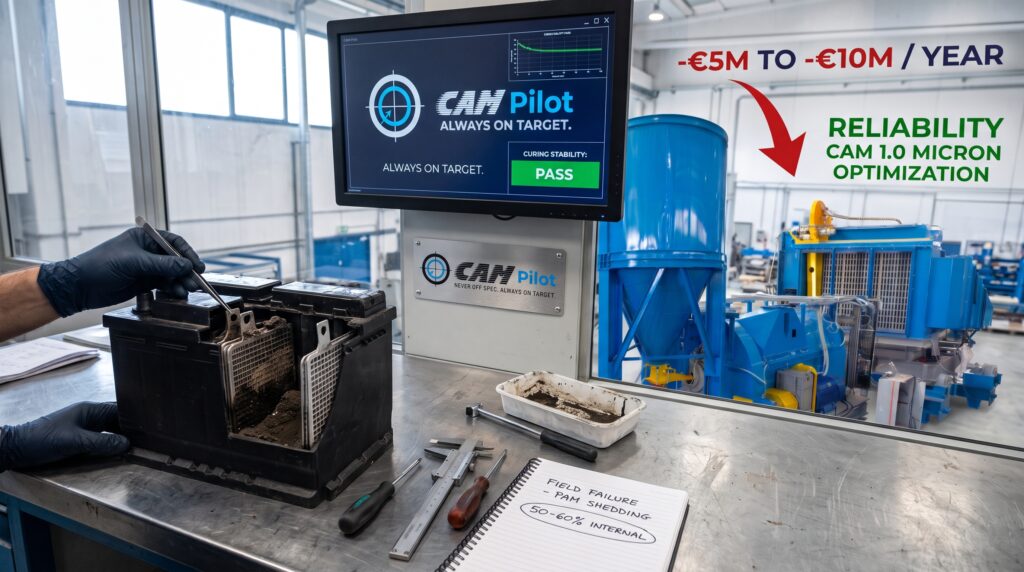
When warranty claims return to the laboratory for destructive tear-down analysis, the root cause becomes undeniable. A minority of failures originate from external user abuse, such as deep sulfation from extended vehicle storage or a faulty alternator overcharging the circuit. However, over 50% to 60% of all field failures originate from internal electrochemical and structural breakdown.
Open the cells and the physical failure is obvious:
- No punctured AGM/PE separators;
- No external thermal burning;
- Only bare positive grid wire networks and a thick accumulation of collapsed, disintegrated lead sludge settling at the bottom of the casing: premature Positive Active Material (PAM) shedding.
The active paste lost mechanical cohesion and stripped away from the cast metal substrate. The battery did not die on the asphalt; its failure was engineered months earlier inside the plant during ball milling and curing.
How to Build a Wall: The Metaphor Anyone Can Grasp
Understanding why an active paste disintegrates under bonnet vibrations does not require complex academic electrochemistry. It functions exactly like a bricklayer erecting a load-bearing wall:
- The cast lead grid is the structural rebar framework;
- The lead oxide powder represents the individual bricks;
- The water and sulfuric acid act as the mortar and cement designed to lock every element into a solid monolithic block.
What happens under strict process engineering?
You supply billions of calibrated micro-bricks, identical in shape and free of stray gravel: an oxide featuring a sharp modal peak at 1.0 micron, locked at 100% tetragonal phase (alpha-PbO) with zero oversize fractions above 25 microns.
When the acid hits the mix, chemical reactions wet the entire surface of each sub-micron grain evenly. No dry pockets remain.
During curing, the mortar and bricks cross-link into a dense, interlocking crystalline network (3BS/4BS). You can strike that wall with a sledgehammer or subject it to continuous engine harmonic vibrations: not a single grain dislodges.
What happens when machine CAPEX is cut on the milling line?
The mill feeds an erratic, coarse powder into the pasting mixer, blending superfine dust with hard, unreactive chunks of 40, 60, or 80 microns.
It is the physical equivalent of building a brick wall by dumping smooth river pebbles and large boulders directly into the mortar:
- Sulfuric acid reacts only with the outer perimeter of the pebble.
- The core remains cold, inert, metallic lead.
- The mortar cannot bond to the unreacted metallic cores, leaving microscopic voids and mechanical stress points throughout the paste.
At the end-of-line electrical tester, electrons flow across the conductive outer shells of the grains.
However, as soon as that battery hits real roads, cyclic heat, and chassis vibrations, the unbonded internal pebbles shake loose. The crystalline matrix collapses, the active mass sheds to the container base, and the battery loses its capacity.
The Curing Chamber: Where the Cement Must Set
If uniform 1.0-micron oxide supplies the calibrated micro-brick, the curing chamber provides the strictly controlled environment where the cement must cure:
- If airflow does not circulate via true horizontal laminar distribution, plates on upper tiers dry differently than those at the bottom of the pallet;
- If coarse water spraying is used instead of direct saturated steam injection, plate surfaces dry prematurely, inducing microscopic surface fractures;
- If final free lead does not drop strictly below 3% and residual moisture below 0.5%, the interlocking basic lead sulfate crystal structure (3BS or 4BS) never completes its growth.
When field return rates climb, typical plant meetings focus on cosmetic band-aids: tweaking expander recipes, increasing acid dosage, blaming separator suppliers, or letting shift operators “add a splash of water” by eye at the mixer.
These are temporary remedies applied over an internal operational fracture.
A surgeon does not treat internal bleeding with an aspirin. You identify the primary organ causing systemic breakdown and fix the process at the thermodynamic root.
Eliminating the Root Cause: Locking Process Parameters
Eliminating the 50% to 60% of field returns caused by structural paste breakdown requires deterministic control over powder reactivity and curing thermodynamics:
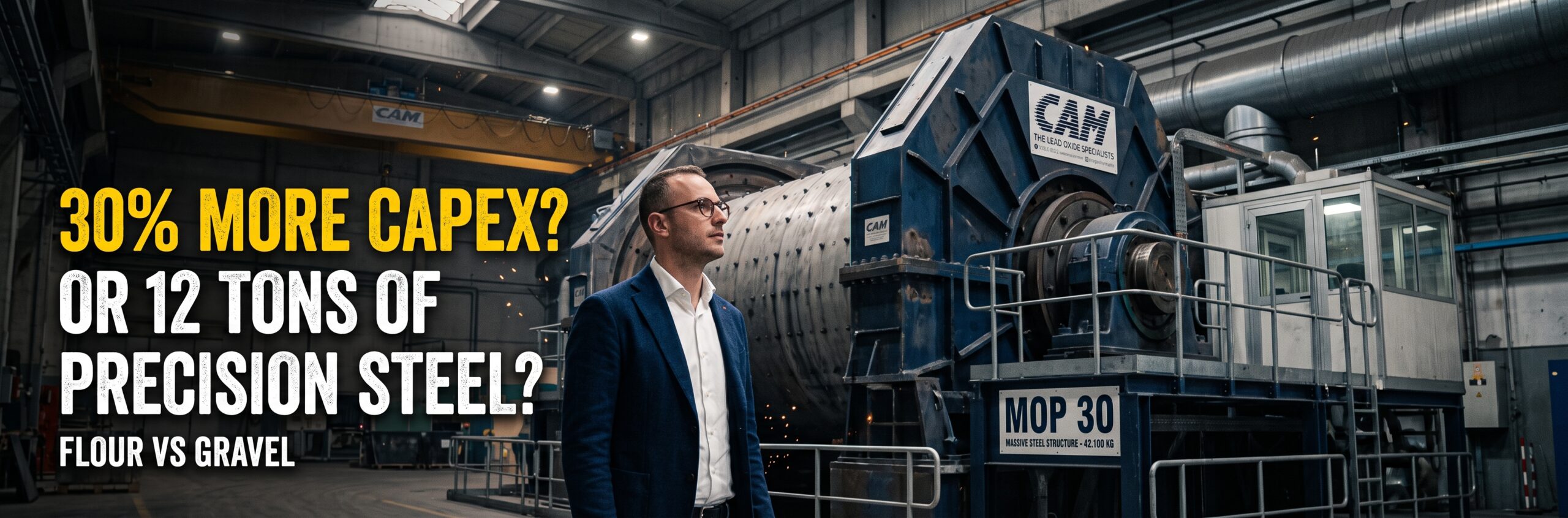
- CAM MOP Ball Mills (42 Tons of Heavy Steel): Over 11.8 tons of additional certified structural mass compared to market averages, housed in an insulated thermal enclosure to deliver an unvarying 1.0-micron modal peak, 100% stable tetragonal phase, and zero fractions above 25 microns.
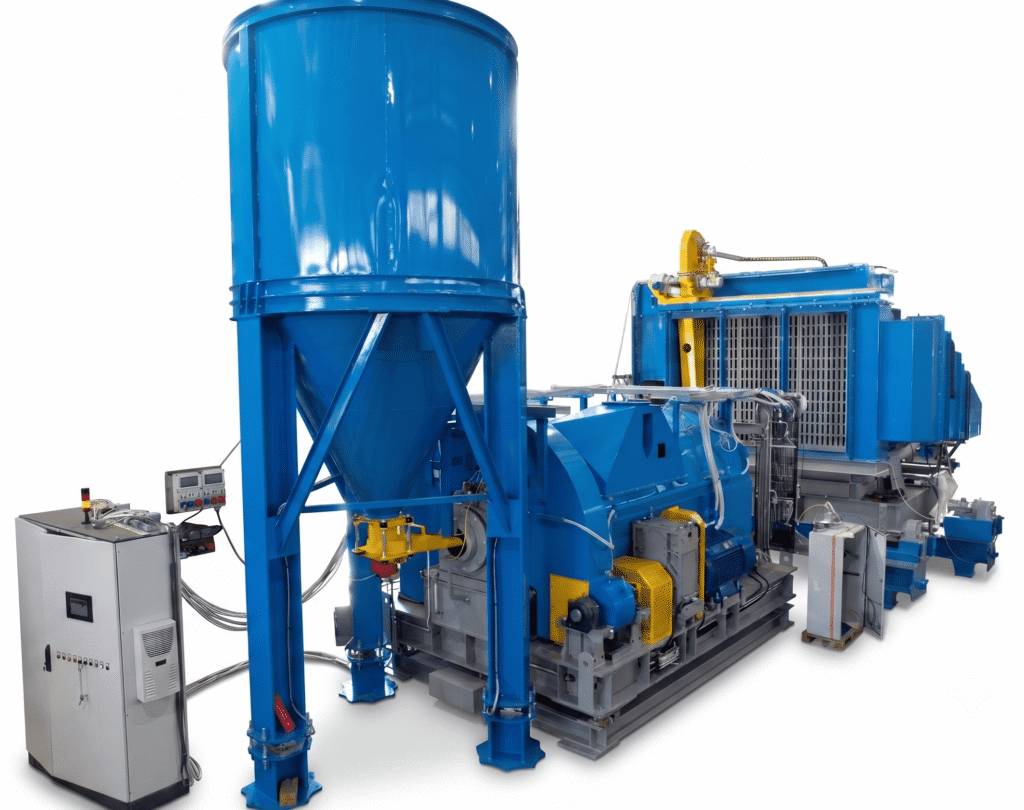
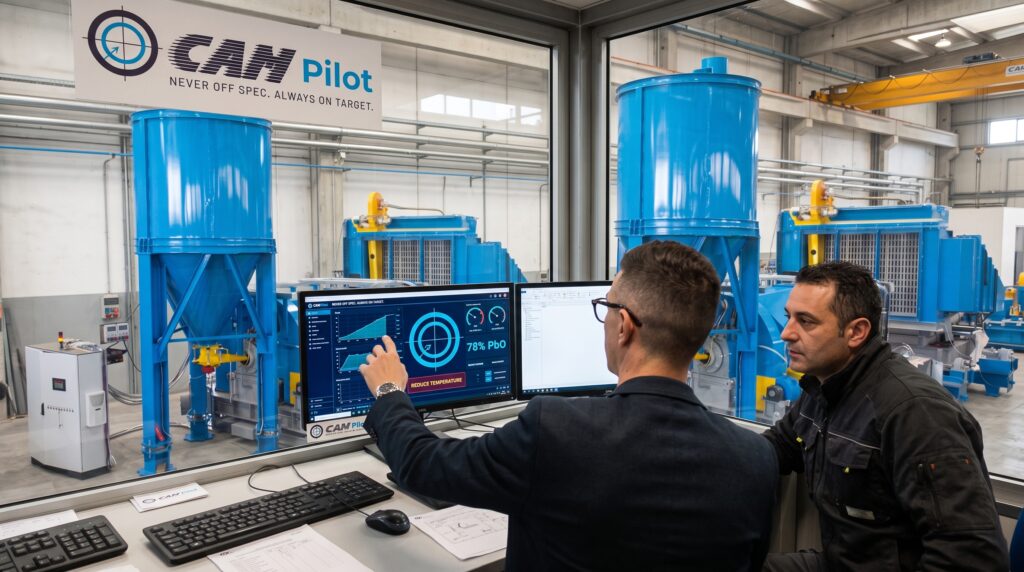
- CAM Pilot (Prescriptive Process Director): In-machine prescriptive intelligence eliminating operator shift-to-shift variance by outputting real-time corrective actions, keeping oxidation firmly within the safe zone 24/7.
- VoltCure amp; Steam Cure Chambers: Horizontal laminar airflow and saturated steam injection guaranteeing uniform basic lead sulfate interlocking, free lead < 3%, and moisture < 0.5% across every pallet tier.
Take the Surgeon’s Stance: Book a Direct Technical Audit
Treating €5M to €10M in annual field scrap as an “unavoidable operational tax” quietly funds competitor efficiencies while putting multi-year supply contracts at risk.
If you are a Plant Director, Technical Director, or General Manager seeking to audit your oxide particle size distribution, curing conversion metrics, and plate structural durability before the market issues its next penalty:
Book a 30-minute Direct Technical Audit with me.
We will examine your current process data based strictly on engineering fundamentals and objective plant metrics.
Francesco Marfisi