Look closely at a cured plate as it leaves the chamber.
In 95% of lead-acid battery manufacturing plants, a critical flaw occurs daily that plant managers either normalize or attempt to mask behind complex chemical adjustments: batch heterogeneity.
Plates positioned in the center of the rack complete the curing phase; plates on the bottom pallets or along the outer perimeter fail. The direct consequences are uncontrolled scrap rates, out-of-spec free lead levels, and structural variance that shortens cycle life before the battery is ever installed.
Stop looking for a magic formula in paste additives. The issue is not chemistry. The issue is fluid dynamics applied to the chamber environment.
1. Root Cause Diagnosis: Asymmetric Airflow
Conventional or obsolete curing chambers operate with an inherent flaw: asymmetric, turbulent airflow.
In an aerodynamically uncalibrated chamber:
- Hot, dry air hits only the outer faces of the pallets, causing rapid surface crusting that seals internal moisture inside the plate.
- Bottom pallets and dead zones lag behind in temperature and humidity gradients.
- Uneven oxidation produces non-uniform batches: excessively brittle plates sitting right next to plates with unacceptable residual free lead.
Plant management sees the deviation on the quality report and attempts to compensate by extending cycle times. Extending cycle time does not fix root causes; it merely bottlenecks plant throughput.
2. The Cost of Delay: The Hidden Tax on Operating Margin
Operating uncalibrated curing chambers drains operating expenditure (OPEX) every working hour:
- Direct Scrap Generation: Scrapped plates after pasting and curing discard active material, grids, energy, and labor straight into internal recycling loops.
- Redundant Energy Consumption: Extending cycles by 6 to 12 hours to force cold spots up to temperature burns gas or kilowatt-hours without adding value.
- Premature Warranty Claims: Structural non-uniformity fails under real-world charge/discharge cycles. End customers face early capacity loss, damaging brand credibility.
Remaining in the status quo is not a zero-cost baseline. It is a continuous financial decision to accept profit erosion on every single megawatt-hour produced.
3. The Engineering Solution: Cubic-Centimeter Atmosphere Control
Eliminating variance requires absolute control over two physical variables:
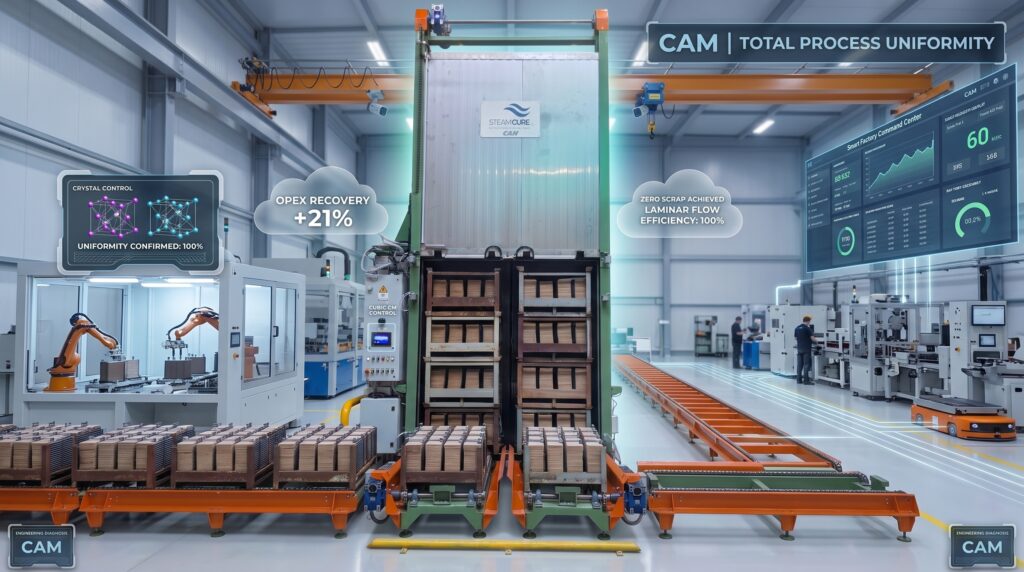
- Horizontal Laminar Airflow: Process air must not move via random, turbulent convection. It must sweep horizontally through every single interstitial gap between plates, maintaining uniform velocity and dynamic pressure from the bottom pallet to the top.
- 1-Bar Saturated Steam Injection: The moisture required to drive exothermic oxidation and form target crystal structures (3BS/4BS) must saturate the entire internal volume instantly and uniformly.
When process atmosphere is identical in every single cubic centimeter of the chamber, variance drops to zero. Cycle times contract to the thermodynamic limit of the reaction, and scrap rates collapse.
Preliminary Technical Diagnosis (2 Slots per Month)
Correcting process imbalances requires specialized engineering expertise that very few manufacturing plants maintain internally. For this reason, I open my calendar for a maximum of 2 Preliminary Technical Diagnoses per month, reserved strictly for facilities running continuous industrial volumes.
This analytical check-up normally carries a substantial engineering fee. If your plant meets baseline production criteria, we absorb the cost of this initial audit to pinpoint OPEX recovery potential across your line.
Slots are restricted: I evaluate layout and production data before confirming availability. Plants choosing the status quo remain fully free to fund their own operational inefficiencies.
To request the preliminary audit assessment form, send a direct message with: “PLANT AUDIT”.
Francesco Marfisi